Wednesday, 4 December 2013

Further Short Film Inspiration - Theme of memory


Research into creating a sense of memory through film

I have been researching several films and techniques in filmmaking which aid in creating a memory or dream like sequence. Although our idea does not have to come across too literally to viewers, we have been trying to think about and plan out how we can visually create the impression that the content is a series of memories and therefore does not necessarily have to flow in a chronological order to viewers.

 
Example - 'Quicksand'
Dir. Lance Oppenheim

http://www.shortoftheweek.com/2013/08/01/quicksand/

A short film that I came across quite early on within this research is 'Quicksand', which is currently featured on the Short of the Week website. This has become a really useful film to come across in my research, as some of the ideas used work very effectively and I feel similar ideas to how the piece comes together could be applied to our own work. Although this film takes more of a documentary style approach, the content is still relevant and has been useful in terms of sparking new ideas for how to visually approach the theme of memory, and in particular, showing forgotten memories.

The use of the flicker effect alongside the blank white space is an element of the film that I felt communicated the concept well and connected the viewer to the character's perspective, as he deals with his own memory loss and concentration on trying to remember.

Watching this short film has given me an insight into how the concept of memories, or pieces of memory can be achieved visually in more ways than one. For example, the way in which the film both begins and ends with snapshot images really gives the viewer the idea that they are being shown memories, and this is something that we could perhaps think about incorporating into our idea in a similar way.

The sound use is also very effective in leading the narrative and focusing on connecting memory with a sense of time within this film, and the clock in particular at the beginning is an idea that I have thought about incorporating  alongside different visual areas of our film.


Sunday, 1 December 2013

Development of Idea


After receiving feedback on our idea, and researching and watching other short films on the theme of memory, we have realised that our idea can be simplified into a experimental piece purely about memory. We have found that this has been much easier to work with, and a lot of our ideas visually fall better into this idea as opposed to the more broad idea we originally had, which was to show life flashing before the eyes before death.

With the memory theme in mind, we have come up with the name 'Fragments' for our piece, as we feel that this fits well within what we intend to show; a series of memories that won't necessarily have to be in chronological order, as memory fades along with time.

Visual elements

In terms of the way that we intend to shoot this, the use of poor focus as well as the possibility of slowing down the shutter speed on some of the visual sequences are ideas that we are experimenting with in order to convey the theme of blurred memories, and thinking back, to the viewer.

Use of repetitive sound - to imply a sense of thinking back/remembering

Recording a range of different repetitive sounds has informed our idea for our opening visual sequence. We intend to have an eye, shot out of focus, along with the sound of a camera clicking each time a blink occurs. This will link into showing the viewer snapshots of memory within the later visuals of the film.

This idea originally came to me when we had a guest lecture on how narrative functions in the still and moving image, and the term 'frozen time' was used to describe photographic time. Our idea incorporates both time along with memory, and how the two can be closely linked together; when time moves on, memory fades. I like the idea of using the camera click audio as early on in the film as possible, as using this idea of 'frozen time', it could imply to the viewer that what they are about to see throughout the duration of the film, is not really happening- but is a moment, and memory, that has been interrupted by the passing of time.


Opening sequence

This is how we are visualising the opening title sequence linking in with the opening establishing shot of the film at this stage:


Monday, 18 November 2013

'The Life Size Zoetrope' and 'Life and Stuff' Reflection


Two experimental short films that I have come across which are similar to our concept are 'The Life Size Zoetrope' and 'Life and Stuff' featured on the FutureShorts website. Both of these short films are useful to refer to when developing our idea, as the theme of life is what we are focusing on within our concept of memories flashing before your eyes in a situation of death.
 
The Life Size Zoetrope(Dir. Mark Simon Hewis)
 
http://www.youtube.com/watch?v=y-75uRHYHWE
 
I really like the cinematography and visual style of this short film, as well as the way that the narrative is told through a mix of both voiceover narration and other background sound use. The pace of the visuals is also interesting and something that we could incorporate into our idea when we add visuals to our audio piece at a later stage. The main aspect of this short film that I have taken away and considered also applying within our own audio as well as visual project is the way in which the start of the piece is repeated at the end, in order to tell the story in a non linear structure. We could perhaps do this with the sounds of beeping hospital machines, or even just a simple concept such as somebody breathing, without the need for a voiceover narration. The short film seems quite busy in terms of the pace as well as mixture of sounds used alongside the visuals, which works well in creating a sense of urgency or feeling of a fast paced life for the audience.

Life and Stuff
(Dir. Kumar Satjunarasa, UK, 2011)
 
http://www.youtube.com/watch?v=rWrmAuEwKRs


This short film has been useful to come across in my research as we are developing our idea, as it features a voiceover narration of a series of events within a single lifetime. Although at this stage we do not aim to include a voiceover narrating our project, this could be an option at a later stage if our concept is still not coming across strongly enough to our audience. I also think we would like to achieve something similar to the simplicity of this short film; the mixture of sounds at the beginning and the end and the background sounds in between. The pace of the piece also adds to the intensity of fitting in a lifetime's worth of memories in a few minutes worth of visuals and audio. This has inspired me to think about the development of our project, in terms of how we could use pace as a tool to create a build up of narrative development within recreating memories. I like the idea of slowing down the sounds that are reflections of the memories within the later stages of life, and speeding up the older, more distant memories. I also like the idea of attaching this with a theme of memory loss as the person is aging mentally as well as physically, in a non- linear structure, although I am not sure that this would be possible given the short running length of the piece.
 

Post - Crit. session feedback - Development of concept


After our crit. session last Thursday (14/11/13), we received some very useful feedback from the rest of the seminar group on our idea as well as initial first cut of our audio project. We are aware after listening to our sound piece through speakers that it sounds quite different to when we had previously listened back to it, and that our main development at the moment needs to be focused upon coming up with solutions as to how we can clearly communicate to the listener the idea behind the piece, which is to be taken through a lifetime of memories in a 'flashing before your eyes' sense through the use of audio .


Some useful feedback that we received suggested possible ideas as to how we could show the development of the different stages of a lifetime in such a short amount of time. With this in mind, we have begun to further work upon the idea of showing weakness from the suggestion below, and a deteriorating state of mind.


Another piece of useful feedback that we received was the idea of including sounds associated with achievements throughout a lifetime, which would help the listener to establish that our piece is a journey through different memories within different stages of a lifetime.

 
With this in mind, I have created a list of the different stages of growing up, and some possible sounds that we could gather which are associated with each of these stages. I found this feedback session very helpful towards the development of our idea, as the concept seems a lot more simplified and easier to work with now, and the feedback received has helped us to explore further areas around how we can go about communicating our idea to our audience.


Wednesday, 6 November 2013

Sense of Place audio project - Inspiration and Experimentation


Inspiration

Films

I have been researching and watching some films that I feel can be used to demonstrate how sound usage can contribute to the idea of exploring a memory or journey of the mind. These have  inspired me to think of new ways of creating our memory inspired audio project on the theme 'sense of place'. Two films that I have watched and found to be particularly useful in my research so far are Donnie Darko (2001) and Eternal Sunshine of The Spotless Mind (2004).

Locations

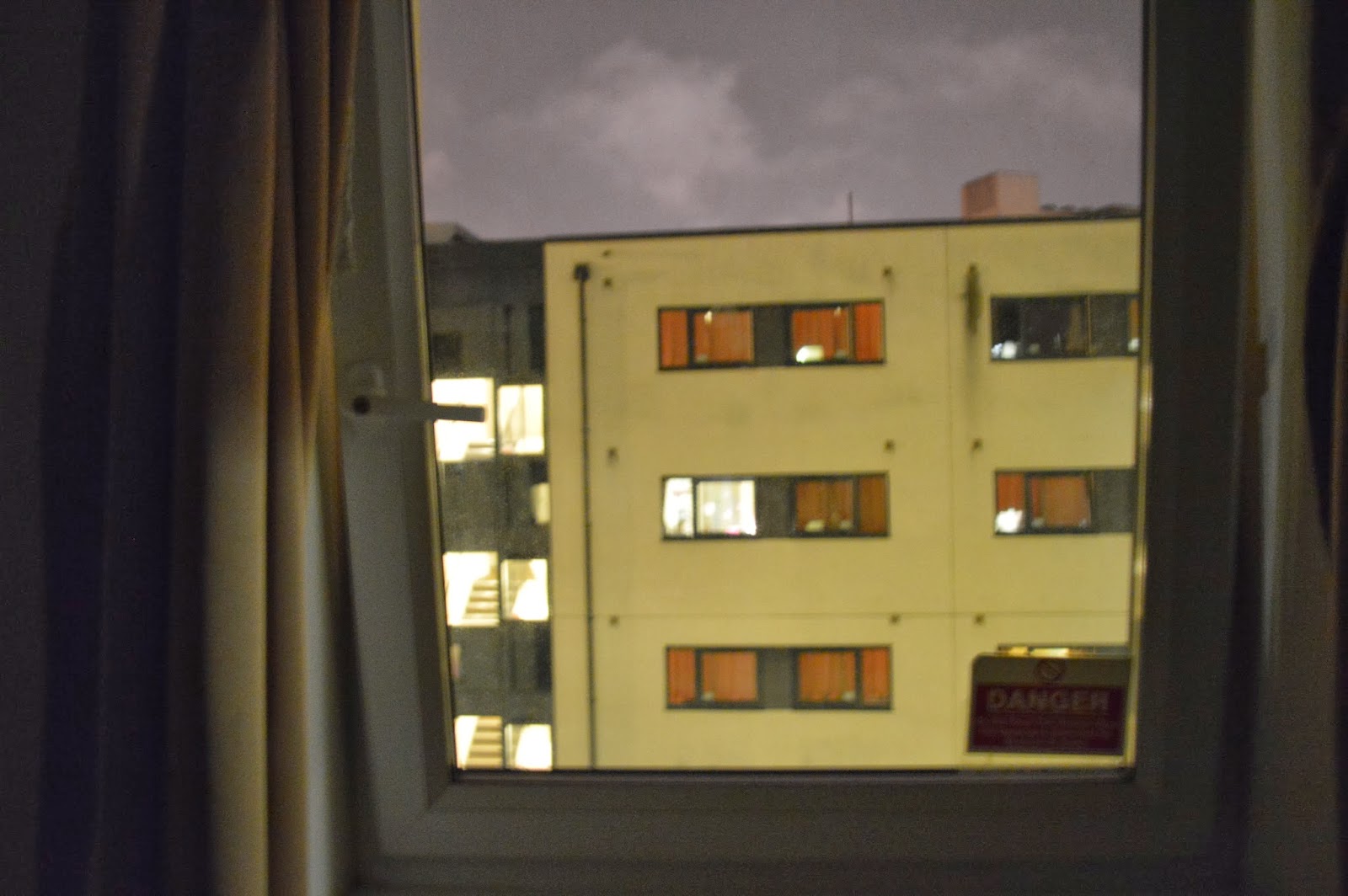
After discussing the possibilities for the future visual content to go alongside this project in the tutorial session, we have been thinking about how to make use of the spaces that are easily accessible and available to us everyday. For this reason, instead of our original initial idea of the visuals being based on a train journey with a window view, we have developed and expanded upon this idea further to come up with a list of possible windows we could use in the visuals. This could be applied as an overall theme to the project ; the windows as objects could be used to direct the narrative and create the impression of the memory montage from the subject's point of view, which could be done even without the need to show the subject in the visuals at all.

Some possible examples of these could be:


A series of windows through another window - in order to generate ideas around the subject of watching and the passing of time, as well as to show the subject's physical location - in this case inside looking outside.


I like the idea of using space as an object - Gaining a closer up view through a window, to create an entirely different meaning, e.g. this door close up could be seen and interpreted as a subject being trapped, whereas the further away shot shows it in its real sense and does not leave much room for exploring narrative interpretations.

Another concept that I have thought about is using smaller spaces to convey meanings (e.g. through key holes, viewers on opposite sides of doors etc.). An idea which is appealing to me is that as the pace as well as tone of the piece progresses, the windows get smaller in size to mirror the subject's emotions/state of mind. This idea would mean that we would also not have to show the subject in person at all visually, but instead focus on the strength of the audio for now. The changing sizes in the windows could be used to represent the memory moving further away from the subject's mind, as they are trying to focus on their personal journey (shown through the visuals) and forget and move on from the memory.


Experimental Audio

The main thing that I am exploring with my research, and would also like to incorporate into my own project is the idea of creating something unordinary out of the ordinary through the use of sound. I wanted to explore some basic, everyday sound and listen back to see if any new ideas or inspirations came to mind. I recorded a few minutes of audio beside an open window, purely to listen back to and discover new thoughts on where else this could have been recorded, other than the location that it was originally. I found this to be a very useful exercise as it has made me realise that for our audio project we won't need to overcomplicate things and can instead find a very simple idea and location and experiment with transforming it into something entirely new.


Monday, 21 October 2013

Sense of Place audio project inspiration


Since last week's seminar, which included walking around Sheffield city centre and gathering ideas and inspiration for our audio projects, Sarah and I have got together in our production team and started thinking about and further discussing our initial ideas. I find the idea behind this project interesting, as usually sound is something that we don’t break down or notice much, until it’s emphasised in a scene, however by noticing the finer details of some of the places we visited, as well as just the city in general, it has sparked my interest and I have gained some early  inspiration towards this project. This was first noticed when we visited the train station, and we discovered how smaller details, such as the beeping of the ATM cash machines could be just as effective in creating a particular mood in a busy place, as the bigger picture- the overwhelming noise of the tannoy systems.

Sarah and I reflected back on the places that we had visited during the morning and discussed which sounds had influenced our ideas and which had stood out to us the most. We agreed that the train station was a particularly interesting starting point; the idea that such a busy place with people rushing around could be transformed into something much more condensed in terms of sound use, and still be effective from a different context and perspective. We agreed that  given the time we have to manage and complete this project, a simple idea would work well, and once we had this, we could then focus in on the finer details. We also decided that collecting extra audio than what will be required for the project will be useful , even if not directly associated with our idea, as it could be added to an archive file which could add to our idea at a later stage during the post production process, and also help us in planning for any contingencies.

With the train station idea still in mind, we thought about the possibilities of an imaginary place in the form of a memory, and having the audio in some way unrelated to the visuals which will be used for our other project at a later stage. Linking back to the first seminar we had, transport and in particular train travel came up as something that inspires us. This got us thinking and talking about  the idea that although everyone is usually busy travelling somewhere and has that in common with other passengers on a train , they are all in their own separate worlds. This is where our initial idea for recording some audio that would be in the form of a memory originated from, however we are aware that this idea needs to be more refined and discussed further before we start planning the finer details of the project.


Keeping with the travel theme, I researched some sound recordists who have recorded audio pieces on similar themes. I remembered attending an event in Newcastle with a sound recordist talking there, and when I looked his name up, I found that he has actually done an interesting audio piece on a train. Although this is recorded on the train and not elsewhere, as we intend our memory audio to be,  it still sparked some ideas and made me think about the busyness side to the train idea.

https://soundcloud.com/michael-maroussas/conversations-on-train-in-suffolk  

Keeping the 'Sense of Place' theme for the project in mind, another inspiration was attending the current Sound Map of Sheffield exhibition by Chris Watson at the Millennium Gallery in Sheffield. Hearing so many different sounds all from the same city made me think about developing the idea of a collection of memories through audio use.
 

Monday, 14 October 2013

Love Me Or Leave Me Alone analysis


Love Me or Leave Me Alone (Duane Hopkins, 2003- 15 min.)


Love Me Or Leave Me Alone is a short film reflecting upon the misunderstandings of a young couple's relationship. The film is set in a vast and open country location, which draws the viewer into primarily focusing on the character's and their situation. The choice to use an empty location also represents the theme of loneliness portrayed throughout the whole film.

The cinematography and sound work together in establishing the film's themes and narrative right from the beginning. The opening shot does not hesitate in setting up the unsettling theme; fast moving camera work immediately shows character Steven (James Firkins) spitting directly onto his girlfriend's face. The film's main narrative from then on is concerned with following the aftermath of an argument, and the viewer is left to establish their own take on what has happened prior to this.

The actual title of the film is not shown until a later stage, and when it is shown, it is displayed at a time which is fitting to the audience's initial understanding of the narrative. The camera work quickens as the subject's argue with one another, representing their parallel views of the same situation. The camera work is disorientating; as well as letting the viewer gain an insight into the angered teenager's states of mind in the distressing situation, it could also be symbolic of the relationship as a whole- the misunderstanding and confusion of the character's relationship. A later shot also shows a washing line shaking outside, from an indoor perspective, which could also be representative of the uncertainty within the situation. Throughout the film, many shots have the character's positioned in the centre, which could further be a way of diverting the audience's focus onto the character's alone.

The lighting is another key element which works well, together with the emptiness of the location, in portraying the dark and unsettling theme of the film. Shots are carefully put together and lit in a way which could be used to convey specific meanings to audiences. One example of this is the scene where Steven is shown inside of a hut, looking out towards his girlfriend after they have argued and she is walking away across the field. The camera is positioned from his perspective, and the shot is almost split directly in half between the outside light and darkness of the shelter. One interpretation of this could be that the split light is representative of his choices; deciding between what is right and wrong, which also clearly links with the film's title.

Another noticeable point throughout this short film is the use of sound, and how this is used successfully as a device to create a sense of building tension for the viewer. At one point (when the girl is shown getting into an unknown car), the sound completely cutting out adds a moment of uncertainty for the upcoming events, which is then followed by a long ongoing shot showing Steven slowly disappearing into the distance through the car's wing mirror.

Although only fifteen minutes in length, this film successfully achieves having a longlasting effect on the viewer, in that it makes them ask questions about its meaning, and the message in which it is trying to convey. The films narrative is based on a fairly simple idea, however different interpretations can be taken from it and I think watching it more than once could change perspectives on what the film is about.